Roof cleaning is the right first step when the roof structure is sound but the surface is dirty, mossy or streaked — and you want to know what you are actually dealing with before committing to coatings. A clean roof reveals cracked tiles, rusted fixings and worn coating that were invisible under years of growth.
It is the wrong first step when there is an active leak, sagging, or widespread broken tiles. Those need a licensed roofer first. Cleaning a failing roof just makes a failing roof look better for a season.
Signs your Adelaide roof needs cleaning
- Dark streaks running down the slope — airborne algae, most visible on light-coloured tiles and Colorbond
- Green cushions in the valleys and along the laps — moss, holding moisture against the tile
- Grey-green crusty patches bonded to the surface — lichen, the hardest of the three to remove
- A dull, uniform film — dust, pollen and salt build-up, common after a dry Adelaide summer
- Blocked gutters full of granular sediment — the roof surface is breaking down
- Damp patches on the south side that never dry out — shaded, sheltered areas hold moisture longest
What is actually growing up there
Understanding the three main organisms explains why a quick rinse never lasts.
Algae is a surface film. It rinses off relatively easily but returns fast because spores land continuously from surrounding trees and neighbouring roofs.
Moss anchors into the tile surface and into the gaps between tiles. It behaves like a sponge — it holds water against the roof long after rain has stopped, which accelerates deterioration of the tile surface and can push water sideways under laps.
Lichen is the stubborn one. It is a fungus and an alga living together, and it bonds chemically to the tile. Physical removal alone tends to leave the root structure behind, and it regrows from what is left.
This is the key point: rinsing removes what you can see; it does not remove what regrows. A wash without a biocide treatment will often look green again within one Adelaide season, particularly in the Hills. Killing the growth at the root is what makes the result last.
Cleaning, coating, or calling a roofer — how to decide
Cleaning first is genuinely diagnostic. Under moss, you cannot see hairline cracks, rust at screw fixings, or how much of the original surface coating is left. We would rather find that on day one than after you have paid for paint.
Pressure, and why it has to match the surface
"Pressure washing" covers a wide range, and the pressure that suits one roof will damage another. Getting this right matters more than any other decision in a roof clean.
Concrete tiles carry a factory-applied surface coating. Excessive pressure strips it, leaving the tile porous — which means it absorbs more water and grows moss faster than before the clean.
Terracotta tiles have a fired glaze that sheds water. Old terracotta is also brittle, and heritage roofs around North Adelaide, Norwood, Unley and Prospect often can't take much foot traffic, let alone aggressive blasting.
Colorbond and metal handle a firm wash well but need care around seams, screw fixings and any existing surface rust.
The other risk with too much pressure is water intrusion. Roof tiles are designed to shed water flowing downhill. Driving water uphill, under the laps, at pressure, puts it into the roof cavity — onto insulation, timber and ceilings.
Our approach is to match pressure to substrate and let chemistry do the work that force shouldn't: a controlled-pressure wash to lift the bulk of the growth, then a biocide treatment to kill the roots, so it stays clean rather than looking clean for a month.
Adelaide's micro-climates change what grows
The city is not one environment, and roofs a twenty-minute drive apart weather very differently.
Adelaide Hills — Stirling, Aldgate, Bridgewater, Mount Barker, Crafers. Higher rainfall, heavy tree cover, damp shade. This is moss and lichen country, and roofs here need attention more often than the plains.
Coastal suburbs — Semaphore, West Lakes, Henley Beach, Glenelg, Brighton, Seacliff. Salt-laden air accelerates corrosion on metal roofs and fixings, and salt film binds dust to the surface. Rinsing salt off matters as much as removing growth.
Inner and northern suburbs — Prospect, Croydon, Mawson Lakes, Salisbury. Predominantly dust, pollen and traffic film, with algae streaking on shaded elevations.
Southern and foothills suburbs — Blackwood, Belair, Coromandel Valley. A middle case: enough tree cover for moss on south-facing slopes, drier than the Hills proper.
What changes the scope of a roof clean
No two roofs take the same amount of work, which is why every job is quoted individually after we have seen it. The variables that matter most:
- Pitch. A steep roof is slower to work and needs more fall protection than a low-pitch one of the same area.
- Access. Narrow side setbacks, retaining walls, established gardens and two-storey sections all change how the job is staged.
- Storeys. Height affects both equipment and the time spent setting up rather than cleaning.
- How embedded the growth is. Light algae film and decades of bonded lichen are different jobs on the same roof area.
- Roof material and condition. Brittle terracotta needs a slower, gentler approach than sound Colorbond.
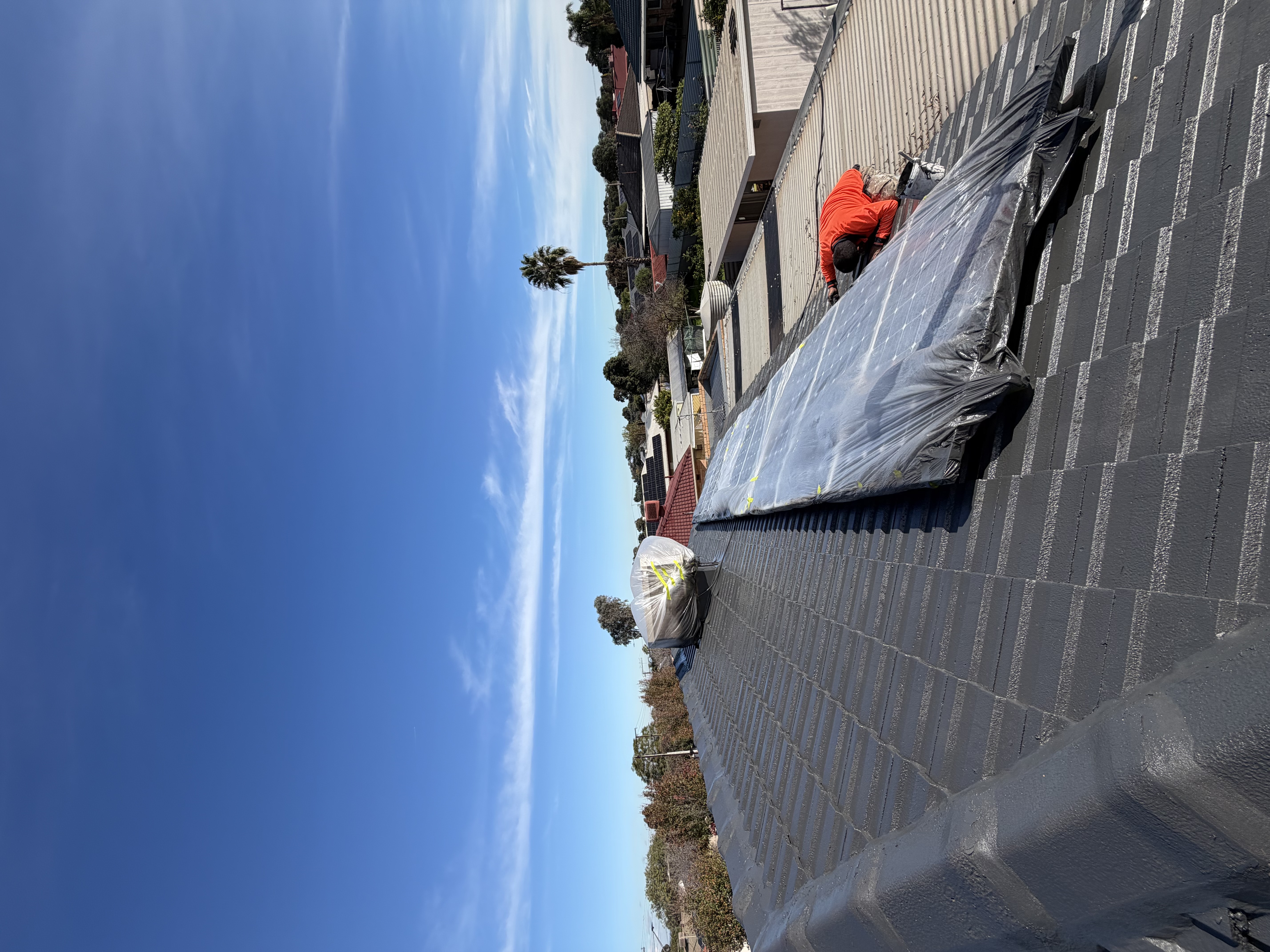
- Solar panels. An array has to be worked around, and run-off managed so debris and treatment don't sit on the cells.
- Rainwater tanks. If you collect roof water, downpipes need diverting before anything is washed or treated.
Anyone quoting without seeing photos or the property is guessing — pitch and access change the labour more than area does.
Safety and the practical side
Roofs are a leading cause of serious falls in home maintenance, and a wet, mossy roof is genuinely slippery. Beyond the fall risk, walking a brittle terracotta or old concrete tile roof breaks tiles — which is how a DIY clean turns into a leak.
If you have solar panels, tell your contractor before they quote. Panels need to be worked around carefully, run-off should be managed so debris and biocide don't sit on the cells, and panel cleaning itself is a separate task.
Also worth planning for: downpipe management. Debris and treatment run-off should be diverted rather than flushed into rainwater tanks. If you collect rainwater, say so up front — it changes how the job is staged.
What Fusion does — and doesn't do
We handle roof care: controlled-pressure cleaning, biocide treatment, roof painting, and minor patching and repairs such as replacing broken tiles and sealing small defects.
We are not roofers. We don't re-roof, we don't do structural repairs, and we don't take on roofs that need major restoration work. When an inspection turns up something outside that scope, we tell you plainly and recommend a licensed roofer — because coating over a roof problem is the most expensive way to delay fixing it.
Frequently asked questions
How often should an Adelaide roof be cleaned? Most roofs benefit from a clean every 3–5 years. In the Hills or under heavy tree cover, every 2–3 years is more realistic. Coastal metal roofs benefit from more frequent rinsing to keep salt off.
Will cleaning damage my roof tiles? Not when the pressure is matched to the substrate and the operator knows where to walk. Damage happens when aggressive pressure strips surface coating or glaze, or when someone walks brittle tiles carelessly.
Do I need to clean the roof before painting it? Yes, always. Coatings cannot bond through moss, lichen, algae or dust, and any growth left behind will keep working underneath the new film.
How long does the result last? With biocide treatment, typically 2–4 years before visible regrowth in most Adelaide suburbs; less in shaded, damp Hills locations. A rinse without treatment can regrow within a single season.
Is roof cleaning worth it if I'm selling? Usually yes — it is one of the highest-visibility improvements to street appeal, and it removes an obvious talking point at inspection.
Can you clean a roof with solar panels installed? Yes, with planning. Let us know at quote stage so we can allow for working around the array and managing run-off.
Can you quote a roof clean over the phone? We can talk you through what is involved, but a firm quote needs photos or a site visit. Pitch, access and how embedded the growth is change the work far more than roof size alone.
Not sure whether your roof needs a clean, a coat, or a roofer? Send us the details and we'll tell you straight. If it's ready for coating, here's how roof painting works in Adelaide.